

See Video: Historical Writings
There is a wealth of ancient writings that show that until allegorisation crept into the church in the second and third centuries AD through Origen (185 - 254), it was the common view of ancient Jewish writers and early Church fathers that, in some way, the seven days of Creation Week represent 7000 years in God's Plan of the Ages. After the reformation, this view began to resurface.
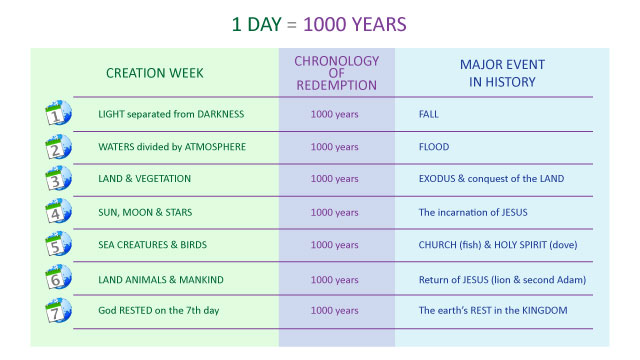
FIGURE: Each 1000 years in God's Plan of the Ages
Ancient Jewish Writers
Ancient Jewish writers seemed to understand that the seven days of Creation Week represent 7000 years and that they form the blueprint of God's Plan of the Ages.
They taught that God's dealing with His people would be encompassed within a “great Sabbath week” lasting 7000 years. It was known from before the time of Christ. One Jewish tradition even attributed it to Elijah.
Edward Gibbon
Historian Edward Gibbon concluded in 'The Decline and Fall of the Roman Empire':
The ancient and popular doctrine of the Millennium was intimately connected with the second coming of Christ. As the works of the creation had been finished in six days, their duration in their present state, according to a tradition which was attributed to the prophet Elijah, was fixed to 6000 years. By the same analogy it was inferred that this long period of labour and contention, which was now almost elapsed, would be succeeded by a joyful Sabbath of a 1000 years; and that Christ, with the triumphant band of the saints and the elect who had escaped death, or who had been miraculously revived, would reign upon earth till the time appointed for the last and general resurrection.
Their duration was fixed to 6000 years
Rabbi Elias, 200 BC
The world endures 6000 years: 2000 before the Law, 2000 under the Law, 2000 under Messiah.
The Tanna debe Eliyyahu
The world is to exist 6000 years. In the first 2000 years, there was desolation (no Torah), 2000 years the Torah flourished, and the next 2000 years is the Messianic era.
Rabbi Ketina
In the Talmud, Rabbi Ketina says:
The world endures 6000 years and 1000 it shall be laid waste [that is, the enemies of God shall be destroyed], whereof it is said, 'The Lord alone shall be exalted in that day.' As out of seven years every seventh [is a] year of remission, so out of the 7000 years of the world, the seventh millennium shall be the millennial [1000] years of remission, that God alone may be exalted in that day.
The Tannaim
In the Talmud, the Tannaim - Rabbis of Christ's day - said:
As there were six days of creation, the world would last for 6000 years. The seventh 'world day' would be the 1000 years of Messiah's rule. (Sanhedrin 97a; Avodah Zarah 9a).
The world would last for 6000 years. The seventh 'world day' would be the 1000 years of Messiah's rule
The Encyclopedia of the Jewish Religion says the Rabbis based this on Psalm 90:4:
For 1000 years in Your sight are as yesterday when it is past.
The Book of Enoch
The Book of Enoch, though not in the Bible, was sometimes quoted by early church writers. Jude quotes from Enoch 1:14-15.
The Slavonic version, the Secrets of Enoch, describes earth’s history from Adam, indicating that it will run 7000 years corresponding to the seven days of creation, and that the seventh millennium follows Messiah’s second coming:
I (God] said to Adam: “Earth you are, and into the earth whence I took you you shall go, and I will not ruin you, but send you whence I took you. Then I can again take you [by resurrection] at My second coming”... And I blessed the seventh day, which is the Sabbath on which He rested from all his works. And I appointed the eighth day also, that the eight day should be the first created after My work, and that the first seven revolve in the form of the seventh thousand, and that at the beginning of the eighth there should be a time of not counting, endless with neither years, nor months, nor weeks, nor days, nor hours.”
The writer moves from talking of the seven days of creation to talking in terms of thousands. The length of each day is to be measured in terms of the seventh day, which is called the 'seventh thousand'. God is telling Enoch that each of the seven days of his creation prefigures 1000 revolutions of the earth around the sun. The mention of revolutions puts this prophecy way ahead of its time in terms of knowledge.
The Secrets of Enoch implies the seventh thousand will be blessed as a time of rest after the Messiah’s return when Adam and his kind are resurrected from the earth. His mysterious eighth day fits the eternal state of Revelation 21 and 22. The larger version of Enoch, containing the material quoted by Jude, also describes the total history of earth as 7000 years.
New Testament
Therefore at the time of the New Testament this was already an established theory. It was in this setting that Peter said:
But do not let this one fact escape your notice, beloved, that with the Lord one day is like a thousand years, and a thousand years like one day. (2Peter 3:8)
Notice he was appealing to something they already knew. To the original hearers, this confirmed that the seven days of Creation Week represent six days or 6000 years of man followed by one great Sabbath Day of the Lord of 1000 years.
Early Church Fathers
The Epistle of Barnabas 1st century AD
The Epistle of Barnabas is from the first century and many early church leaders believed it to be genuinely written by the Barnabas of the New Testament, including Origen, Jerome, Clement and Eusebius. Though not part of the Bible, it tells us about the beliefs of the early church:
God made in six days the works of His hands, and He finished them on the seventh day, and He rested the seventh day, and sanctified it. Consider, my children, what that signifies He finished them in six days. The meaning of it is this, that in 6000 years the Lord God will bring all things to an end. For with Him one day is a 1000 years, as Himself testifies, saying, 'Behold, this day shall be as a 1000 years'. Therefore, children, in six days, that is in 6000 years, shall all things be accomplished. And what is it that He says, and He rested the seventh day, He means this; that when His Son shall come, and abolish the season of the wicked one [the antichrist] and judge the ungodly and shall change the sun and the moon, and the stars, then He shall gloriously rest in that seventh day. (Barnabas chapter 15)
Irenaeus AD 150
In Against Heresies he stated a belief held by the early church:
This is an account of the things formerly created, as also it is a prophecy of what is to come. For in so many days as this world was made, in so many thousand years shall it be concluded. For the day of the Lord is as a 1000 years; and in six days created things were completed, it is evident therefore, that they will come to an end at the sixth thousand years.
Edward Gibbon
Historian Edward Gibbon says that...
The 7,000 year Plan of God was carefully inculcated in the early church. Both Jews and Christians knew of this from the first century and before.
Lactantius AD 300
In chapter 14 of his Divine Institutes, the christian scholar Lactantius says:
We, whom the Holy Scriptures instruct to the knowledge of the truth, know the beginning and the end of the world, respecting which we will now speak in the end of our work. Therefore let the philosophers, who enumerate thousands of ages from the beginning of the world, know that the six thousandth year is not yet completed, and that when this number is completed the consummation must take place.
He also said:
Because all the works of God were finished in six days, it is necessary that the world should remain in this state six ages, that is 6000 years. Because having finished the works He rested on the seventh day and blessed it; it is necessary that at the end of the 6000th year all wickedness should be abolished out of the earth and justice should reign for a 1000 years.
Methodius, Bishop of Tyre AD 300
Methodius pointed out that the reason Adam died at the age of 930 years (Genesis 5:5) and did not reach the age of 1000 was due to God’s prophecy in Genesis 2:17:
Since a day was equal to 1000 years in God's sight, Adam had to die before the day (1000 years) was completed.
Also:
For since in six days God made the heaven and the earth, and finished the whole world and blessed the seventh day and sanctified it, so by a figure in the seventh month, when the fruits of the earth have been gathered in, we are commanded to keep the Feast (of Tabernacles) to the Lord, which signifies that, when this world shall be terminated at the 7000 year, when God shall have completed the world, He shall rejoice in us.
Hippolytus
Hippolytus said:
6000 years must needs be fulfilled that the Sabbath may come.
More writings could be produced from other early Church Fathers, including Victorinus, Bishop of Petau, Justin Martyr and Jerome (translator of the Vulgate Bible) to support the argument that the early church believed the Millennium would start at the end of 6000 years from Adam.
Later Christian Scholars
Bishop Latimer AD 1552
Some Reformation scholars understood that the sabbatical week of 7000 years indicated that the end would occur in our generation. Bishop Latimer said:
The world was ordained to endure, as all learned men affirm, 6000 years. Now of that number, there be passed 5552 years [as of AD 1552], so that there is no more left but 448 years (ending in AD 2000).
Archbishop Ussher
In the 17th century, Archbishop Ussher’s famous chronology included the same assumption.
Although some of these ancient Jewish writers and early Church Fathers had differing ideas, they all believed that in some way or other the seven days of Creation Week represent six days or 6000 years of man followed by one great Sabbath Day of the Lord of 1000 years.
See Video: Historical Writings
